
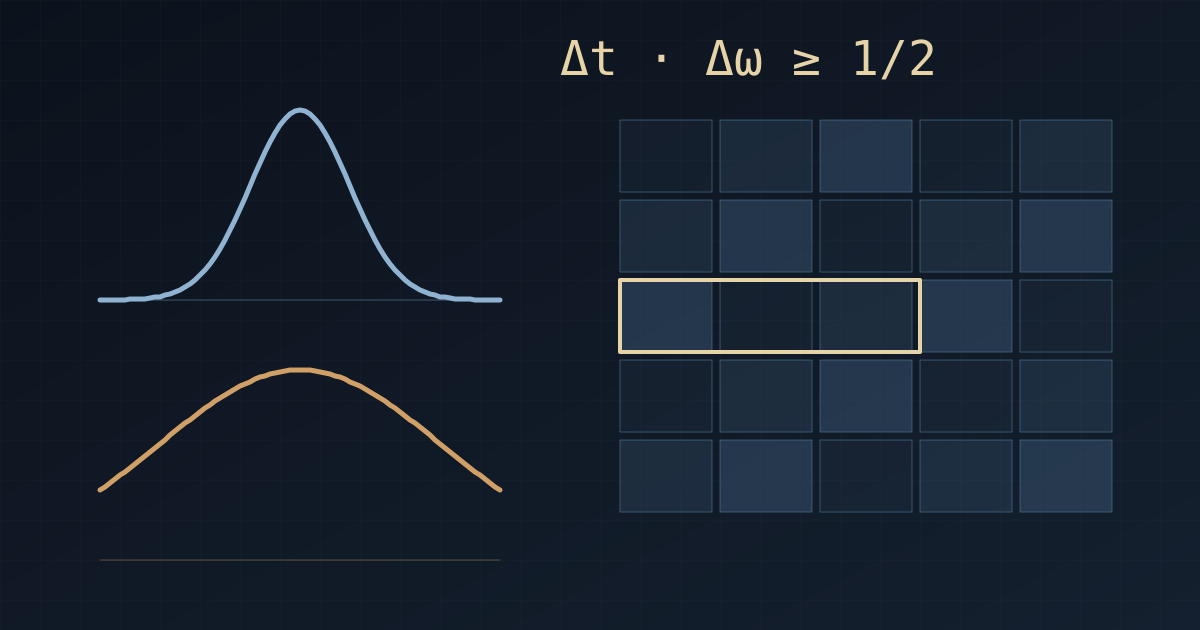
The ordinary Fourier transform is a unitary transform: information is fully preserved, and the inverse transform reconstructs the original signal exactly. This commonly raises a question: if not a single bit of information is lost, why does “uncertainty” still exist? The conclusion of this article is that the uncertainty principle constrains not the total amount of information, but the local readability of that information. It should be stressed that unitarity belongs only to the ordinary Fourier transform: its windowed version (the short-time Fourier transform) and the wavelet transform are merely isometries, not unitary operators. They preserve the norm but are not surjective, and the reproducing-kernel structure of their range provides precisely the sharpest formulation of the uncertainty principle in the time-frequency domain. The article first states the Heisenberg–Weyl inequality and its proof, then explains through three mechanisms (the phase slope, the time-order invariance of the magnitude spectrum, and the reproducing kernel of the range) why invertibility does not provide local readability, and finally verifies the limits of the wavelet transform’s advantage with a cross-band dual-task example, from which a directly computable criterion for method selection is derived.